
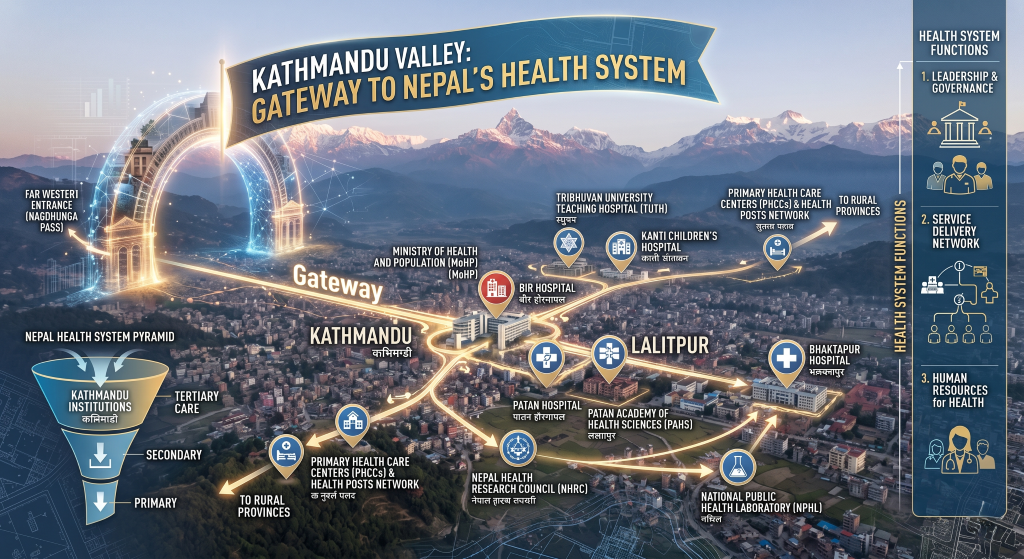
Kathmandu is often the first impression international students have of Nepal, but for medical students it can become much more than a starting point. The capital is the country’s main center for medical education, specialist healthcare, research, and public health activity, bringing together large hospitals, teaching institutions, private healthcare providers, laboratories, NGOs, and community organizations. For students joining a Travel With Purpose program, Kathmandu offers an opportunity to see how healthcare operates in a developing, rapidly changing urban environment while also experiencing the culture and everyday life of the Kathmandu Valley.
Depending on the program, students can visit hospitals and healthcare institutions, meet doctors and other health professionals, observe different clinical settings, and gain insight into areas such as emergency medicine, pediatrics, maternal and child health, diagnostics, rehabilitation, neurology, public health, and community-based services. The experience can be particularly valuable for students who want to compare the healthcare systems they are familiar with at home with the realities of medical practice in Nepal. They can see how hospitals manage high patient numbers, how specialists and general healthcare providers work together, and how families navigate healthcare services when cost, availability, and location can influence their choices.
Kathmandu also provides a useful setting for understanding the relationship between health and society. The city has grown rapidly over the years, bringing together people from almost every part of Nepal and creating a diverse urban population. Alongside modern hospitals and medical facilities, students can observe traditional lifestyles, local food practices, changing patterns of work and the challenges that come with rapid urbanization. Issues such as air quality, sanitation, waste management, road safety, mental wellbeing, access to healthcare, and health education can be understood more clearly when students see the city beyond the hospital environment. Community visits and interactions with local organizations can add another dimension to the experience, allowing students to understand how public health initiatives are designed and delivered at the local level. Kathmandu’s cultural setting makes the experience even richer. The narrow streets, historic courtyards, temples, monasteries, markets, and neighborhoods of the valley provide a living introduction to Nepal’s history and traditions. Students can spend time exploring places such as Patan and Bhaktapur, taste local food, meet people from different communities, and experience a city where centuries-old traditions exist alongside modern life. For many international students, these everyday encounters become some of the most memorable parts of their visit.
Through Travel With Purpose, Kathmandu can therefore serve as both an academic base and a gateway to understanding Nepal. Students can begin the day learning from healthcare professionals and spend the afternoon exploring the social and cultural environment in which those professionals work. The combination encourages students to look at medicine from a wider perspective—not only as the diagnosis and treatment of illness, but also as a service shaped by communities, resources, culture, policy, and social conditions. For students considering an international medical experience, Kathmandu offers the opportunity to learn in a new healthcare setting, meet people from different backgrounds, and experience a country where traditional culture and modern medicine continue to develop side by side.
It is an introduction to Nepal that combines professional exposure with genuine cultural immersion, making the city an important part of a meaningful Travel With Purpose study tour.